

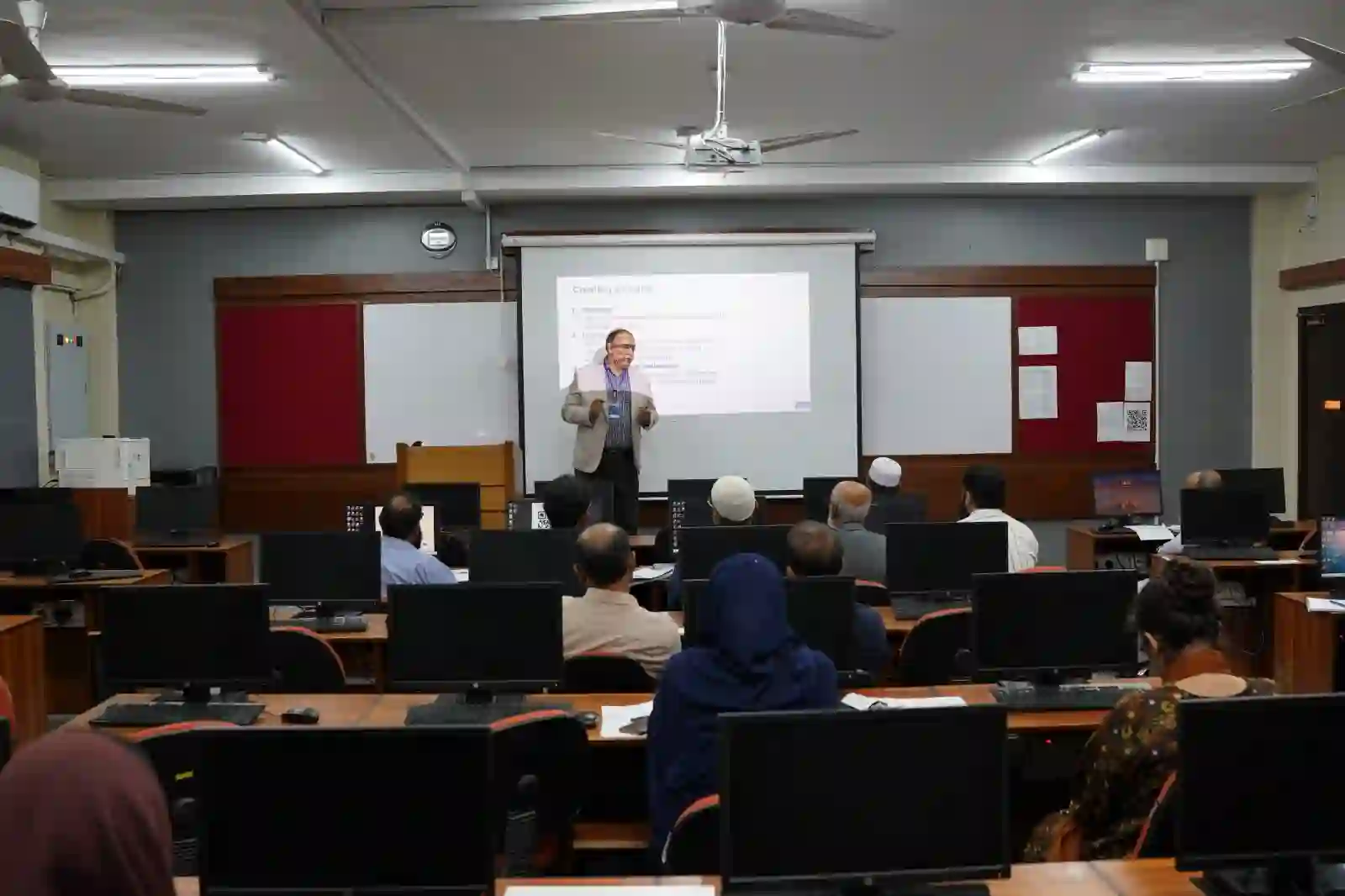
As part of its Faculty Engagement Week (FEW) 2026, UIT University conducted its third Faculty Development Program (FDP) session on “How to Design Complex Problems and Complex Activities for Students” on September 9, 2026.
The session was led by Dr. M. Ghazanfarullah Khan, Professor of Electrical Engineering, UIT University, who shared valuable insights into developing meaningful and challenging learning experiences that encourage students to think critically, analyze complex situations, and apply their knowledge to solve problems.
The session focused on effective approaches to designing complex problems and learning activities that go beyond conventional classroom exercises. Faculty members explored ways to develop purposeful academic tasks that encourage students to analyze information, identify challenges, develop solutions, and engage more actively with the learning process.
Particular emphasis was placed on creating learning activities that foster critical thinking, analytical reasoning, creativity, problem-solving, and deeper learning. By incorporating appropriately challenging and context-based problems into teaching, faculty members can provide students with opportunities to apply theoretical concepts to practical and intellectually engaging situations.
The session provided faculty members with practical perspectives on designing activities that are aligned with learning objectives while encouraging student participation, independent thinking, collaboration, and meaningful engagement.
The third session of the Faculty Development Program 2026 reflects UIT University’s continued commitment to enhancing teaching practices and strengthening faculty capacity. Through professional development initiatives, the University supports its faculty in adopting innovative and student-centered approaches that contribute to an effective and engaging learning environment.
Through Faculty Engagement Week 2026, UIT University continues to promote a culture of continuous professional development, innovative teaching, critical thinking, and academic excellence.