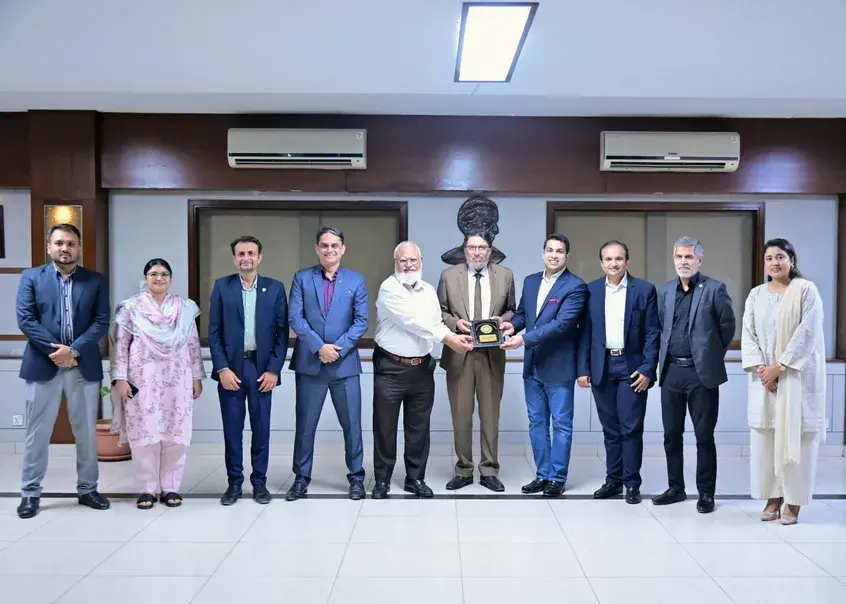
A high-level delegation from UIT University, led by Vice Chancellor Dr. Vali Uddin, visited the Korangi Association of Trade and Industry (KATI) to explore opportunities for strengthening collaboration between academia and industry and creating greater professional opportunities for students and graduates.
The UIT University delegation was warmly received by Senior Vice President Syed Farrukh Ali Qandhari and Vice President Nasir Ali Shaikh. The visit provided a platform for both sides to discuss potential areas of strategic collaboration and ways to build stronger connections between academic education and Pakistan’s industrial sector.
Discussions focused on opportunities to expand structured internship programs, direct recruitment pathways, and industry-sponsored research for UIT University graduates. Such partnerships can provide students with greater exposure to professional environments while enabling them to apply their academic knowledge to practical industrial challenges.
The engagement also explored ways to strengthen technology integration and student development within the industrial landscape of Karachi. By connecting academic coursework with the practical requirements of the manufacturing and industrial sector, UIT University aims to enhance experiential learning and equip engineering and technology students with relevant skills for the evolving job market.
Collaboration between universities and industry plays an important role in developing future-ready graduates by creating opportunities for practical training, professional exposure, research, and employment. UIT University’s engagement with KATI reflects its continued focus on strengthening academia–industry linkages and creating meaningful pathways for students to transition from academic learning to professional careers.
Through initiatives that bring academia and industry closer together, UIT University continues to support innovation, practical learning, career development, and the preparation of skilled graduates who can contribute effectively to Pakistan’s technology and industrial sectors.